

● Toxicology Revenue Cycle Specialists
Toxicology Billing Services for Drug Testing Claims
Claim Click Solutions manages panel coding and medical necessity documentation for toxicology labs, helping practices avoid payer scrutiny and denials.


Trusted by independent toxicology laboratories and reference labs nationwide.
97.6%
Clean claim rate

● The Real Cost of Generic Billing
Toxicology billing breaks in ways standard medical billers never catch
Every one of these compliance and coding traps is costing your lab tens of thousands in uncollected revenue every month.
Presumptive vs. Definitive Sequencing Errors
Billing definitive testing (LC-MS/MS) without matching presumptive orders or failing strict frequency limitation rules triggers instant payer rejections.
LCD / NCD Policy Mismatches
Failure to track localized Medicare contractor (MAC) rules and commercial payer medical necessity policies leads to high rates of unappealed denials.
Unbundled Panel Coding
Incorrectly reporting individual drug class codes instead of consolidated HCPCS/CPT panel codes creates severe compliance exposure and recoupment risks.
Inadequate ICD-10 Justification
Missing or non-specific diagnosis codes linked to drug screening orders cause automated medical necessity denials across major commercial plans.
Payer Audit Exposure
ZPIC, MAC, and RAC audits target toxicology labs relentlessly. Incomplete physician signature logs and requisition trails invite devastating clawbacks.
Out-of-Network & PPO Repricing Discrepancies
Unmanaged out-of-network claims get severely underpaid through silent PPO discounts and arbitrary fee schedule reductions.
● How We Fix It
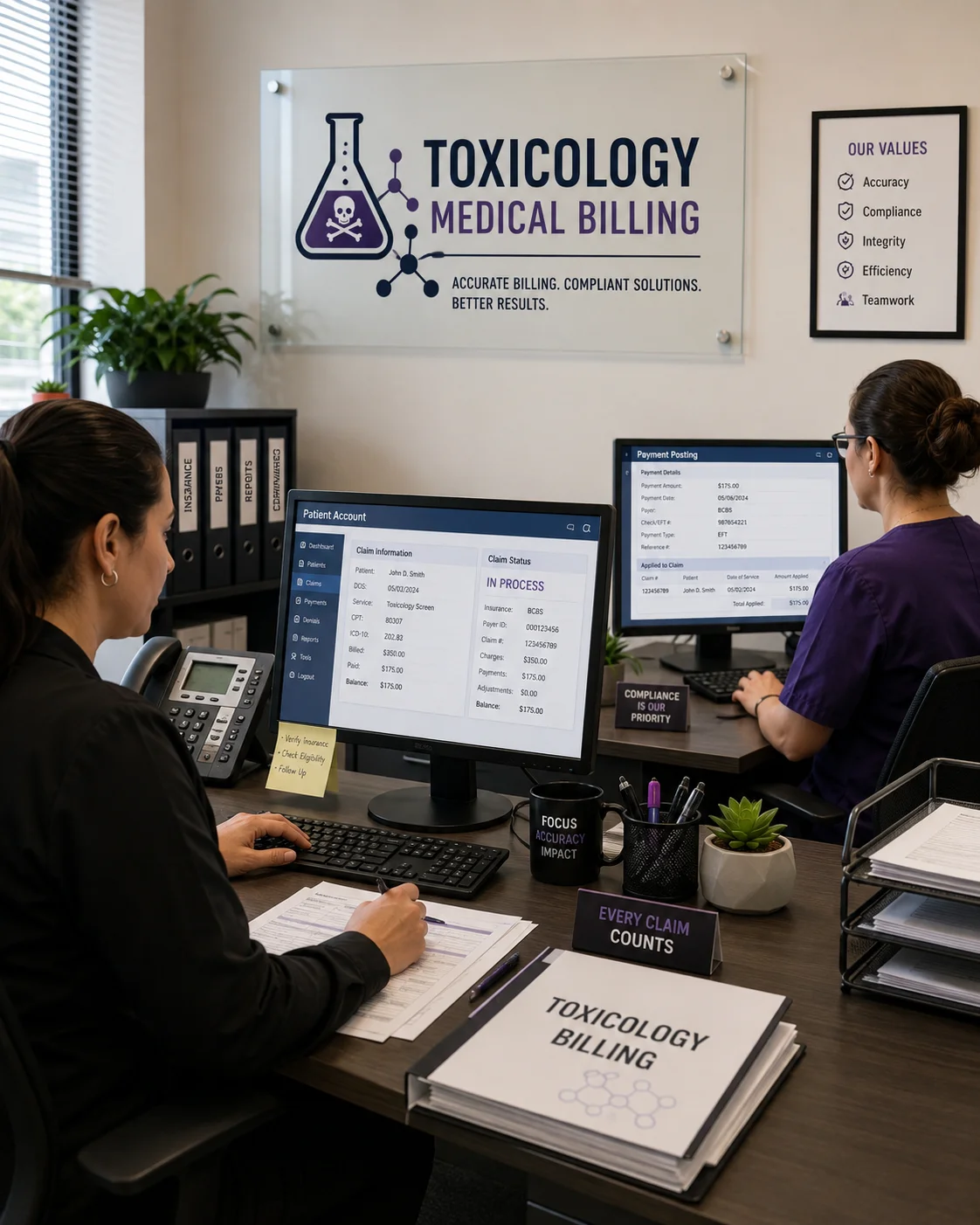
A revenue cycle framework engineered exclusively for toxicology laboratories
We don't treat your lab like a standard physician practice. Every coder and biller on your account specializes in laboratory compliance, chemistry panels, and high-complexity test reimbursement.
Lab-certified coding specialists
Experts trained in CPT 80305–80307 presumptive codes and 83925 suite definitive LC-MS/MS codes.
Automated LCD & NCD policy engine
Insurance verified before or at check-in, even during peak walk-in hours, so coverage surprises don't happen after treatment.
Aggressive denial & appeal defense
Every clinical denial is met with structured medical records, physician notes, and explicit scientific justification.
OON & contract negotiation support
Protecting your lab from predatory out-of-network repricing and maximizing contracted fee schedules.
● Full-Service Laboratory RCM
Every stage of toxicology revenue cycle management
From electronic order entry verification to appealed complex denials, we manage the entire financial pipeline of your laboratory.
Insurance Verification & Eligibility
Real-time verification of laboratory benefits, network tier status, and prior authorization requirements before sample processing.
Presumptive & Definitive Coding
Precise coding for qualitative immunoassay (presumptive) and quantitative LC-MS/MS (definitive) drug classes compliant with all MAC policies.
Clearinghouse Claim Scrubbing
Automated and manual pre-submission edits checking for NCCI PTP edits, medically unlikely edits (MUEs), and diagnosis matching.
ERA & Payment Posting
Accurate electronic remittance advice (ERA) posting, contractual adjustment tracking, and secondary payer auto-routing.
Clinical Denial Appeals
Rigorous appeal workflows targeting medical necessity, frequency limits, and lack of physician signature rejections with full scientific backing.
AR & Patient Balance Recovery
Systematic aging AR follow-up with commercial payers and compassionate, compliant patient billing workflows for patient responsibility balances.
● Built For Toxicology Specifically
We master the complex coding structures of advanced drug testing
No learning curve on laboratory terminology — our billers already understand your instrumentation, panels, and payer requirements.
● Why Practices Switch to Us
What actually changes when Claim Click Solutions takes over
● The Bottom Line
What specialized urgent care billing does for your practice
No learning curve, no generic templates — just billers who already know the codes your center uses every single shift.
● Case Study
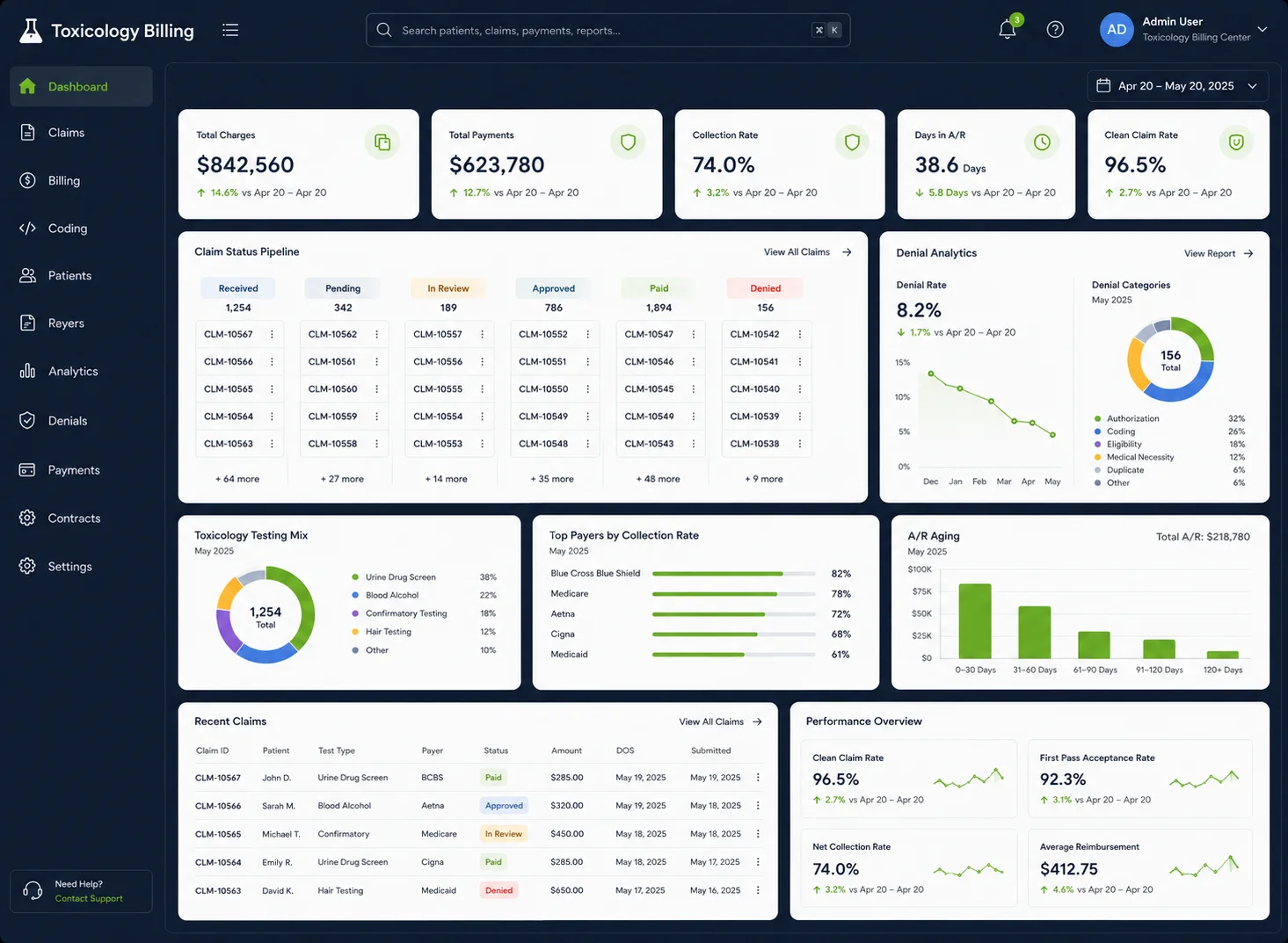
A revenue cycle platform built for visibility, not guesswork
Every claim and denial updates in real time — so you're never waiting on a phone call to know where your money is
● Common Questions
Urgent care billing FAQ
What makes urgent care billing different from general medical billing?
Urgent care claims combine high patient volume, same-day ancillary services (labs, X-rays, procedures), payer-specific S-codes, and place-of-service distinctions (POS 20 vs. POS 23) that generalist billers routinely miss. Getting it right requires coders trained specifically on urgent care visit types.
Do you handle both POS 20 and POS 23 billing correctly?
Yes. Every claim is coded with the correct place-of-service designation based on where and how care was delivered, so you're never underpaid or denied for a POS mismatch.
Can you bill workers' comp and employer-sponsored visits?
Yes, dermatology billing can be quite complex. From differentiating between cosmetic and medical procedures to keeping up with changing insurance policies and CPT/ICD-10 coding, there’s a lot to manage. Accurate documentation and specialized billing knowledge are essential to reduce denials and maximize reimbursement.
Are you compliant with EMTALA and the No Surprises Act?
Yes. Our billing workflows are built around current CMS, HIPAA, EMTALA, and No Surprises Act requirements, and we track regulatory changes that affect urgent care billing specifically.
How much revenue can my urgent care practice realistically recover?
Results vary by practice, but urgent care clients typically see meaningfully higher clean-claim rates, fewer denials, and faster reimbursement within the first two quarters. A free billing audit will give you numbers specific to your practice.
● Case Study
See exactly what your current billing process is missing
We'll review a sample of your recent urgent care claims and show you where revenue is being left on the table — no cost, no obligation.