

● Urgent Care Revenue Cycle Specialists
Urgent Care Billing That Keeps Up With Walk In Volume


Trusted by urgent care centers and multi-site groups.
97.6%
Clean claim rate

● The Real Cost of Generic Billing
Urgent care billing breaks in ways general billers never catch
Every one of these is a claim your practice has probably already lost money on this month.
Wrong place-of-service codes
POS 20 vs. POS 23 confusion silently underpays or triggers automatic denials on high-volume walk-in visits.
Mis-coded S-codes
Billers unfamiliar with urgent care default to standard E/M codes instead of payer-required S-codes, leaving money on the table visit after visit.
Same-day ancillary services missed
On-site labs, X-rays, and procedures performed the same visit get billed late — or not at all .
Eligibility skipped at check-in
Fast-moving walk-in traffic means insurance isn't verified before treatment — denials surface days later, with no recourse.
Compliance blind spots
EMTALA, the No Surprises Act, and shifting payer rules create exposure for billing teams that aren't tracking urgent-care-specific regulation.
Staffing that can't flex with volume
Seasonal and daily patient swings overwhelm in-house billers, creating backlogs that turn into unworked.

● How We Fix It
A billing team built around urgent care's pace, from check-in to payment
We don't hand your claims to generalists. Every coder on your account is trained specifically on urgent care visit types, S-codes, and place-of-service rules.
Urgent-care-certified coders
AAPC-certified specialists who know S-codes, POS 20/23 logic, and same-day ancillary billing cold.
Same-day eligibility checks
Insurance verified before or at check-in, even during peak walk-in hours, so coverage surprises don't happen after treatment.
Active denial rework
Denied claims are corrected and resubmitted — repeatedly, until paid — not filed away.
Volume-flexible staffing
Our billing bench scales with your patient volume, so a busy flu season never becomes a claims backlog.
● Full-Service RCM
Every stage of urgent care revenue cycle management
From eligibility checks to appealed denials, we run the parts of your revenue cycle that pull attention away from patient care.
Insurance Verification
Real-time eligibility checks fast enough to keep pace with walk-in traffic, confirming coverage before treatment.
Charge Capture & Coding
Every visit, lab, X-ray, and procedure captured and coded correctly — S-codes, CPT, ICD-10, and HCPCS, by urgent care specialists.
Claim Submission
Clean claims scrubbed against payer-specific edits before they ever leave the building — fewer rejections, faster payment.
Payment Posting
ERA/EOB reconciliation posted daily so your AR reports always reflect what's actually been collected.
Denial Management
Every denial is diagnosed, corrected, and appealed with the documentation urgent care payers require.
AR Management & Patient Billing
Aging claims worked back to payment, plus clear, timely patient statements that improve self-pay collections.
● Built For Urgent Care Specifically
We speak fluent S-codes for every visit type you see
No learning curve, no generic templates — just billers who already know the codes your center uses every single shift.
● Why Practices Switch to Us
What actually changes when Claim Click Solutions takes over
● Your Revenue Cycle, Step by Step
From check-in to payment — nothing sits idle
This is the exact sequence every urgent care claim moves through before it reaches payment.
● The Bottom Line
What specialized urgent care billing does for your practice
No learning curve, no generic templates — just billers who already know the codes your center uses every single shift.
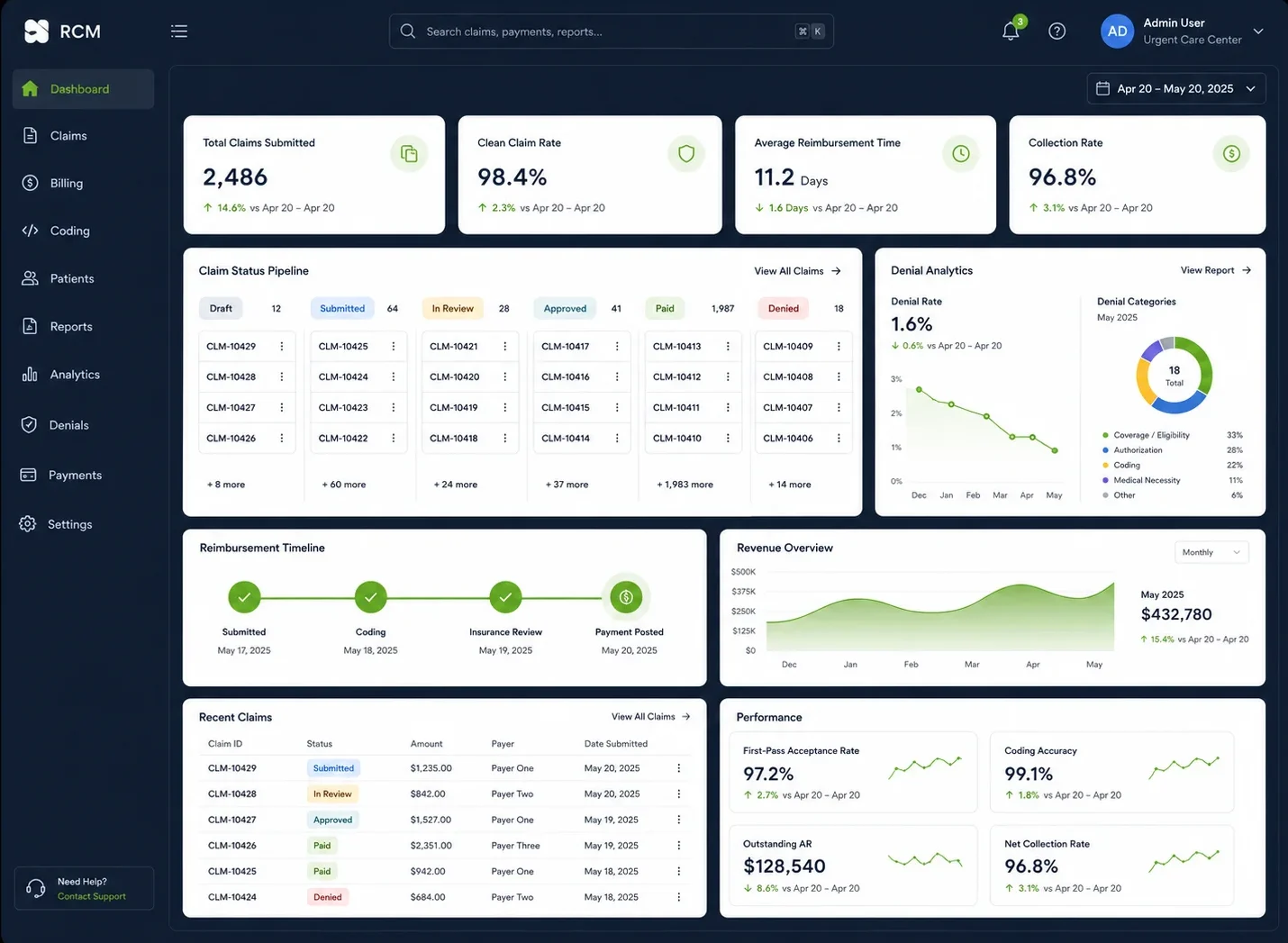
● Case Study
A revenue cycle platform built for visibility, not guesswork
Every claim and denial updates in real time — so you're never waiting on a phone call to know where your money is
● Common Questions
Urgent care billing FAQ
What makes urgent care billing different from general medical billing?
Urgent care claims combine high patient volume, same-day ancillary services (labs, X-rays, procedures), payer-specific S-codes, and place-of-service distinctions (POS 20 vs. POS 23) that generalist billers routinely miss. Getting it right requires coders trained specifically on urgent care visit types.
Do you handle both POS 20 and POS 23 billing correctly?
Yes. Every claim is coded with the correct place-of-service designation based on where and how care was delivered, so you're never underpaid or denied for a POS mismatch.
Can you bill workers' comp and employer-sponsored visits?
Yes, dermatology billing can be quite complex. From differentiating between cosmetic and medical procedures to keeping up with changing insurance policies and CPT/ICD-10 coding, there’s a lot to manage. Accurate documentation and specialized billing knowledge are essential to reduce denials and maximize reimbursement.
Are you compliant with EMTALA and the No Surprises Act?
Yes. Our billing workflows are built around current CMS, HIPAA, EMTALA, and No Surprises Act requirements, and we track regulatory changes that affect urgent care billing specifically.
How much revenue can my urgent care practice realistically recover?
Results vary by practice, but urgent care clients typically see meaningfully higher clean-claim rates, fewer denials, and faster reimbursement within the first two quarters. A free billing audit will give you numbers specific to your practice.
● Case Study
See exactly what your current billing process is missing
We'll review a sample of your recent urgent care claims and show you where revenue is being left on the table — no cost, no obligation.